Why Google Ads Is Getting More Expensive in 2026
Why Google Ads Cost Per Lead Has Doubled in 2026
If your Google Ads have felt harder this year, it isn’t just you.
Across the lead generation accounts I manage, the cost of getting each enquiry has more than doubled in the past twelve months.
Most people blame Google for this. Google is part of it. But the bigger reason is simpler, and you’re probably part of it yourself: people don’t search the way they used to.
I’m Nick Cao, a Google Ads and Meta Ads expert in Sydney, with 15 years in digital marketing and over $240 million in revenue generated for my clients.
Here’s what’s going on, and what I’m telling my clients to do about it.
What the numbers show
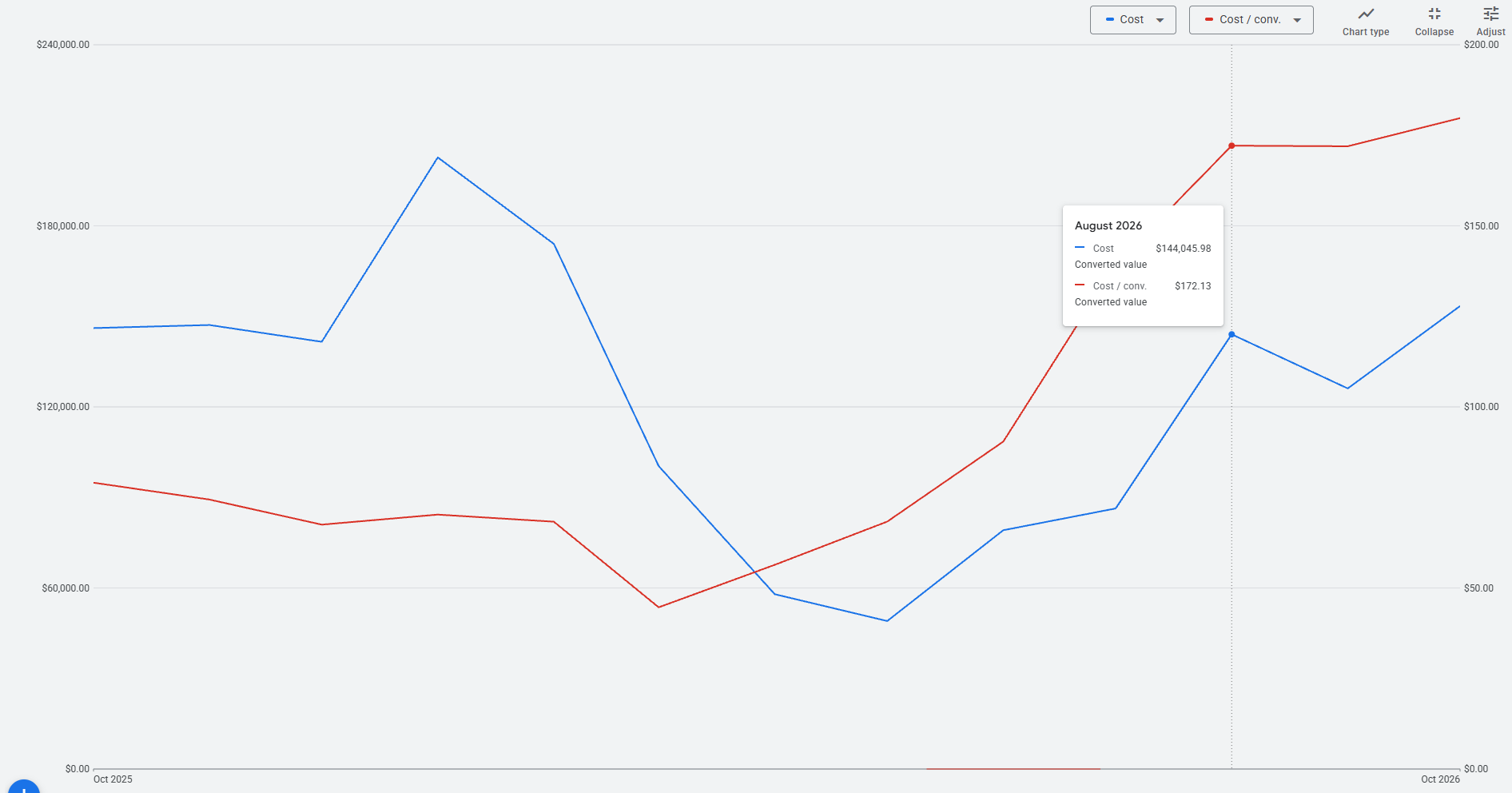
Look at the red line. That’s what each enquiry cost.
- October 2025: under $80
- March 2026: under $50, the cheapest point of the year
- From May: climbing every month
- August 2026: $172
- October 2026: around $180
And it isn’t because these businesses spent more. In January they spent more than at any other point, and each enquiry cost around $70. In October they spent less than January and paid more than twice as much per enquiry.
The accounts didn’t change much. The market did.
The real reason: people are searching differently
Think about the last time you had a question. A few years ago, you’d have typed it into Google. Now there’s a good chance you asked ChatGPT, Gemini or another AI tool instead.
Millions of Australians are doing the same thing.
- 13.6 million Australians used AI tools in an average four weeks in early 2026. That’s 58% of everyone aged 14 and over. ChatGPT alone reached 10.5 million people (Roy Morgan).
- Only 40% of Australians now go to Google first when researching something to buy (Oysterly Media).
- Among younger Australians it’s just 26%. Three in four start on social media or AI instead.
So someone who used to type “best family lawyer Parramatta” into Google might now ask ChatGPT, “Who’s a good family lawyer in Parramatta and what should I expect to pay?” They get an answer straight away. They never see a Google search page, and they never see your ad.
Why that pushes your costs up
Here’s the simple version.
Fewer people are searching, but just as many businesses are advertising. When there are fewer customers to go around and the same number of businesses bidding for them, each one costs more. It’s an auction, so prices rise.
The people still searching are harder to win. Many have already asked AI, read a few answers, and narrowed it down. By the time they reach Google they’re comparing options, which makes them pickier and more expensive to convert.
Even Google itself is answering more questions. Google now shows its own AI answer at the top of many searches. Some people read that answer and stop there.
Put those together and you get exactly what the chart shows: the same budget, buying fewer enquiries, month after month.
Google is also less predictable
On top of the change in how people search, Google has been changing its search page constantly. In May 2026 it made a major update to how it ranks results and expanded its AI answers (Pulse). That’s almost exactly when costs started climbing in these accounts.
I can’t prove one caused the other. But when the page your ads appear on keeps changing, results become harder to plan around.
“But the reports say Google Ads got cheaper”
You may have seen that. WordStream’s 2026 report says the average cost per lead on Google Ads went down for the first time in five years (WordStream).
That’s true for the period it covers, which ended in March 2026. My accounts were cheaper over that time too. The rise started after their data stops. The reports simply haven’t caught up yet.
What this means for your business
Google Ads isn’t dead. When someone searches for exactly what you sell, being right there is still one of the best places to spend money.
But relying on Google for most of your enquiries is riskier than it used to be. You’re paying more to reach a shrinking group of people, and the price can double in a few months without you changing a thing.
Why I’m moving budget into Meta Ads
Remember where people now start: social media and AI, not Google. That’s why I’ve been advising many clients to move part of their budget into Meta Ads, meaning Facebook and Instagram.
The two work in completely different ways:
- Google waits for people to search. You can only reach them once they’re already looking, and everyone else is bidding for them at the same moment.
- Meta finds people before they search. Your ad appears in front of people who match your ideal customer while they’re scrolling. Far more people, and far fewer competitors reaching them well.
Meta has also just made its ad system much smarter. Its latest update, Andromeda 2.0, is better at matching each ad to the right person. I’ve explained it in plain English in my article on Meta Andromeda 2.0.
The clients who have shifted budget to Meta have seen a noticeably better cost per closed deal. That means what it actually costs to win a paying customer, which is the only number that really matters.
What I recommend
1. Keep Google, but trim it. Keep your ads running on the searches that bring in people ready to buy now. Cut the broader, more expensive searches that aren’t paying their way.
2. Give Meta a proper go. A real budget, several different ads, and a couple of months to learn. One ad for two weeks isn’t a test. If you’re new to it, start with my guide to how Facebook lead ads work.
3. Judge every channel by cost per customer. Not cost per enquiry. Meta enquiries often look cheaper and close at a lower rate. Google enquiries often look expensive and close well. The fair comparison is what each one costs you per paying customer.
4. Call new enquiries fast. People who enquire from Facebook weren’t searching for you. They need a quick call from someone who can actually sell, not just book a time.
5. Check your numbers every month. Things are changing quickly. A budget split that’s right today might need adjusting in three months.
The bottom line
People have changed how they look for answers. More of them ask AI or start on social media, fewer start on Google. That leaves more businesses fighting over fewer searches, which is why Google Ads keeps getting more expensive.
The businesses that do well from here won’t pick one channel and hope. They’ll go where their customers actually are, and keep checking what each customer really costs.
Not sure where your ad budget should go?
I manage Google Ads and Meta Ads for service businesses across Australia, personally. If your cost per enquiry has been climbing, let’s work out where your money should be going.
Book A Session With A Sydney-Based Digital Marketing Expert.
I work with a limited number of clients to keep quality high and focus sharp. If you’re ready to grow and want to see if we’re the right fit, fill out the form and let’s start the conversation.
More Insights & Strategies