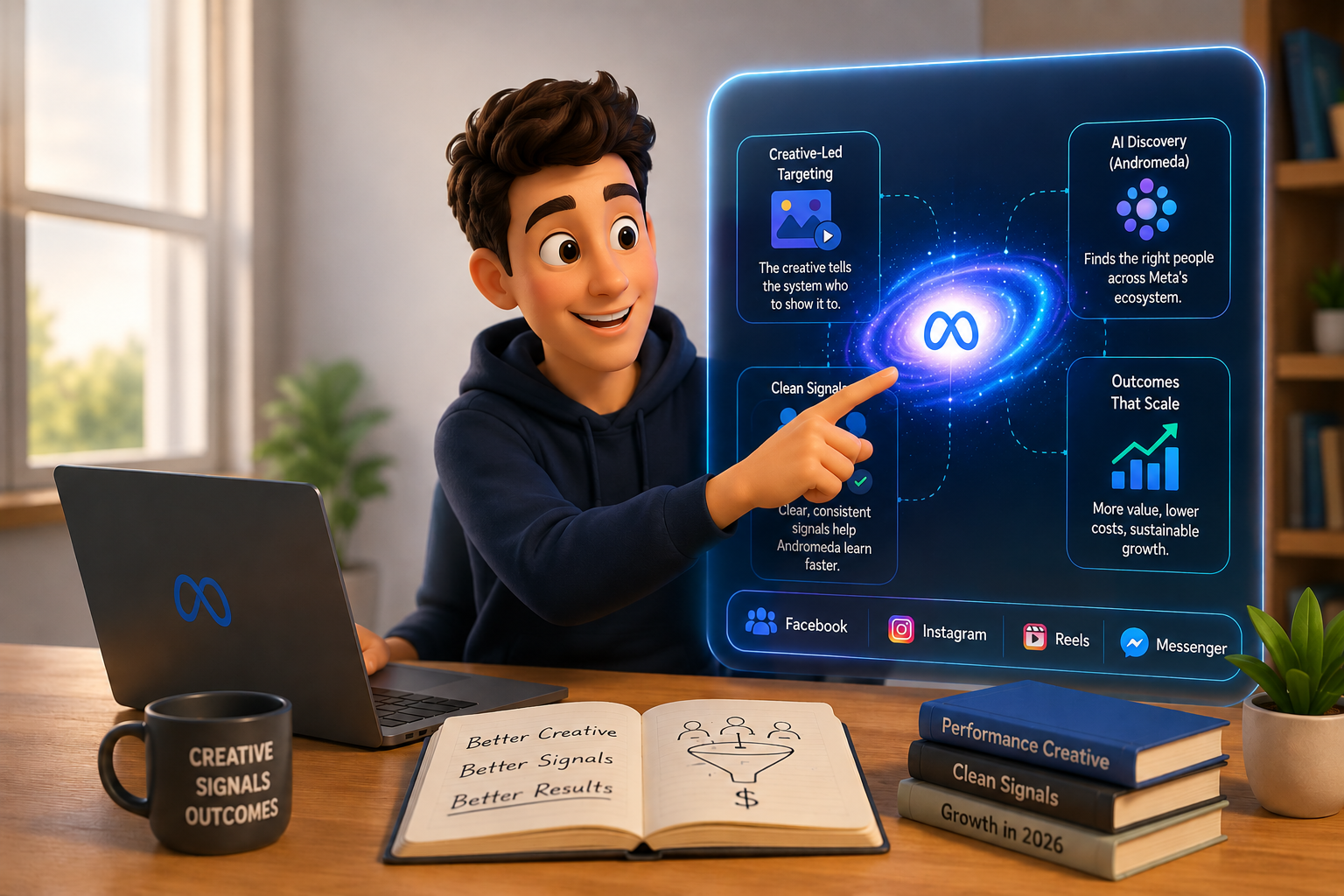
Advertising’s Biggest Lever Is Something No Algorithm Can Fix

Nick Cao • March 28, 2026

Why Creative and Offer Matter More Than Any Google or Meta Ads Optimisation


There’s a hard truth most advertisers don’t want to hear.


Your campaigns aren’t underperforming because of CBO vs ABO, manual vs smart bidding, audience stacking, campaign structure hacks, or some secret algorithm trick.


It’s almost always one thing.

Your creative isn’t strong enough.
Your offer isn’t compelling enough.


Everything else is just noise.


You’re not marketing to algorithms. You’re marketing to humans.


Yes, platforms like Google and Meta Ads are incredibly sophisticated. Their systems are smart, fast, and constantly optimising in the background.


But here’s what people forget.


They don’t buy.

Humans do.


No bidding strategy can save an ad that nobody cares about. No targeting setup can fix an offer that feels “meh.” If the message doesn’t land, nothing else matters.


The mistake most advertisers make is obsessing over settings while ignoring substance.


I see it constantly. Someone spends weeks tweaking audiences, exclusions, placements, budgets, bid strategies, and attribution models. They’re deep in the dashboard, moving knobs and pulling levers, convinced the next configuration will unlock performance.


Meanwhile, they’re still running the same average creative.


Same boring headline.
Same stock photo.
Same safe copy.
Same generic offer.


Then they wonder why results are flat.


It’s like rearranging furniture in a house that’s on fire.


When you zoom out, advertising performance usually comes down to just three things: your offer, your creative, and everything else.


Guess which two drive most of the results?


The offer answers, “Why should I care?”
The creative answers, “Why should I stop scrolling?”


If you fail either of those, you lose before the auction even starts. Not because of CPMs or bidding strategies, but because of psychology.


This is the part most “platform geeks” miss.


Algorithms don’t magically create demand. They simply optimise for behaviour — clicks, watch time, engagement, and conversions.


So when your creative is strong, everything gets easier. Your click-through rates go up. Your CPCs go down. CPMs get cheaper. You generate more data, the system learns faster, and performance improves almost automatically.


You don’t force efficiency.

You earn it.


Great ads make the algorithm look smart. Bad ads make you blame the algorithm.


Yes, structure matters. But not nearly as much as people think.


Switching from ABO to CBO, testing more audiences, or moving from manual to automated bidding might get you a small lift. Five percent. Maybe ten.


But changing the creative or the offer? That can double or triple results overnight.


I’ve seen CPLs drop by 60 percent, CTRs double, and conversion rates triple — all from one new angle or offer alone. No settings changed. Just better messaging.

That’s leverage.


Creative wins because humans don’t buy logically.

They buy emotionally.


They act when something feels urgent, relevant, desirable, obvious, or low risk.


That response comes from positioning and psychology.


A spreadsheet can’t manufacture desire.

But a killer hook can.


If you want real leverage, focus where it actually matters.


Strengthen the offer so it’s easier to say yes. Add stronger guarantees, better bonuses, clearer outcomes, less risk, and faster results. When the offer feels irresistible, conversion rates skyrocket naturally.


Sharpen the hook so it stops the scroll in the first three seconds. If you can’t capture attention immediately, the rest of your ad doesn’t exist.


At Nicreated, we treat ad platforms like distribution channels, not magic machines.


The real work happens before we ever open the ad account — the message, the angle, the psychology, the offer strength, and the creative concept.


Because once the ad resonates, scaling becomes easy.


You’re not pushing a rock uphill.

You’re letting it roll downhill.

And that’s how advertising should feel.

Book A Session With A Sydney-Based Digital Marketing Expert.

I work with a limited number of clients to keep quality high and focus sharp. If you’re ready to grow and want to see if we’re the right fit, fill out the form and let’s start the conversation.

More Insights & Strategies

Learn Google Ads in 2026
By Nick Cao June 14, 2026
Learn how Google Ads really works in 2026, from AI Max and Smart Bidding to the signals that quietly decide your cost per lead. Plain English, no fluff.
Learn Meta Ads in 2026
By Nick Cao June 14, 2026
Learn how Meta ads really work in 2026, from Andromeda and creative-led targeting to the signals that quietly decide your cost per lead. Plain English, no fluff.
By Nick Cao May 23, 2026
A true story about blended ROAS, multi-touch attribution, and the most expensive mistake business owners make with their ad budgets. Last year I had a client. Let's call him David. Not his real name. Real story. David sold a premium Aussie product. He was spending around $12,000 a month on ads. Seven on Meta, five on Google. One Monday he rang me, very pleased with himself. "Nick, I'm cutting Meta. Meta's ROAS is 1.8. Google's is 6.4. Why am I paying Zuckerberg to lose money?" It sounded like the most logical thing a human being could possibly say. My gut said don't do it. I'd seen this exact pattern half a dozen times. The healthy brand search. The suspiciously high Google ROAS. The Meta number that looked worse than it really was. It had the fingerprints of a feeder channel doing quiet, unglamorous work. I told David. He insisted. The client is the client. So I let him do it. Six weeks later, revenue had dropped 41%. Google's spend had doubled. Google's ROAS had collapsed from 6.4 to 2.9. Branded search had quietly cratered. His Shopify dashboard looked like a man holding a melting ice cream in the rain. He hadn't cut the bad channel. He'd cut the engine feeding the good one. The number that actually matters Here's the question David never asked. While his blended ROAS was sitting at 4.0, why did it matter that Meta looked weak? It didn't. That's the whole point. Blended ROAS is total revenue divided by total ad spend across every channel in the same period. That's the entire formula. It doesn't care what Meta claims. It doesn't care what Google claims. Platforms don't get a vote. The denominator is total money out. The numerator is total money in. The bank account decides. Before David cut Meta: $12,000 spend, $48,000 revenue. Blended ROAS of 5.0. After: $10,000 spend, $29,000 revenue. Blended ROAS of 2.9. If the blended number is healthy, the machine is working. Full stop. You don't need to surgically optimise the channel that looks ugliest in isolation. You need to keep the whole thing humming. Channel reporting is never 100% accurate The Singular ROI Index 2026, a global mobile ad benchmark, found that Meta campaigns measured under multi-touch attribution show up to 50% higher ROAS than the same campaigns measured under last-click. Industry overlap analysis suggests 30 to 60% of conversions across multi-channel accounts involve more than one channel touching the customer, meaning a meaningful share of sales get claimed by multiple platforms at the same time. Then Meta changed its attribution model in March 2026, redefined what counts as a click, and most accounts saw their reported numbers drop overnight. Nothing about the actual business changed. Only the dashboard did. Meta sees Meta. Google sees Google. Neither sees the customer who watched a Reel, forgot the brand name, Googled it three days later, abandoned a cart, opened an email on Sunday, and finally bought on Tuesday. If you optimise to a number that's wrong by a margin you can't see, you'll make confident decisions that destroy your business. Like David did. This is where human judgment earns its keep You can buy software that promises to fix attribution. Triple Whale. Northbeam. Rockerbox. They're useful. They're also not the answer on their own. They give you better data. They don't tell you what to do with it. The call David needed wasn't in any dashboard. It was the call that said: "Your blended ROAS is 5.0. Your brand search is climbing. Your Meta number looks bad in isolation because Meta is doing the work Google is getting credit for. Don't touch it." That call comes from having watched this exact movie play out across hundreds of accounts and knowing how it ends. This is what years of doing the job actually buys you. Not certainty. Pattern recognition. Knowing which weak-looking channels are doing real work behind the scenes, and which weak-looking channels are genuinely weak. A junior media buyer reads the dashboard and reacts. Someone who's seen the pattern reads the dashboard, ignores the obvious move, and makes the right call anyway. We turned David's Meta back on. Blended ROAS climbed to 5.7. Branded search returned. The platforms are interested parties, each selling you a version of reality that flatters its own bill. Your blended ROAS is the only number none of them can spin. And the judgment to trust it, even when one channel looks ugly, is the difference between scaling a business and accidentally dismantling one.
SHOW MORE