Do Nothing: The Most Underrated Move in Paid Advertising
The best move when your ads tank might be the one you don't make.
Something feels off with your campaigns. Costs are up. Leads are down. ROAS is sliding. The dashboard looks like a crime scene.
Your instinct says act. Change something. Do something.
Here's what I've learned after years of managing ads through pandemics, platform algorithm overhauls, rate hike cycles, and global trade chaos: the worst decisions are almost always made in the first 48 hours of a performance dip.
The best move is often to do nothing.
The world is loud right now. Your campaigns can hear it.
Advertising doesn't operate in a vacuum. When the broader environment shifts, paid performance shifts with it.
Think about what advertisers have navigated in the last few years. COVID consumer behaviour whiplash. The iOS 14 tracking collapse. Inflation-driven cost of living pressure. US tariffs rattling global supply chains. Stock market volatility shaking consumer confidence. Platform algorithm changes hitting without warning.
The data reflects this. In early 2025, 94% of US advertisers expressed concern about tariff impacts on their campaigns. Nearly half planned to cut budgets as a direct response. IAB revised its full-year 2025 US ad spend forecast down from 7.3% growth to 5.7% as macro sentiment soured through the second half of the year.
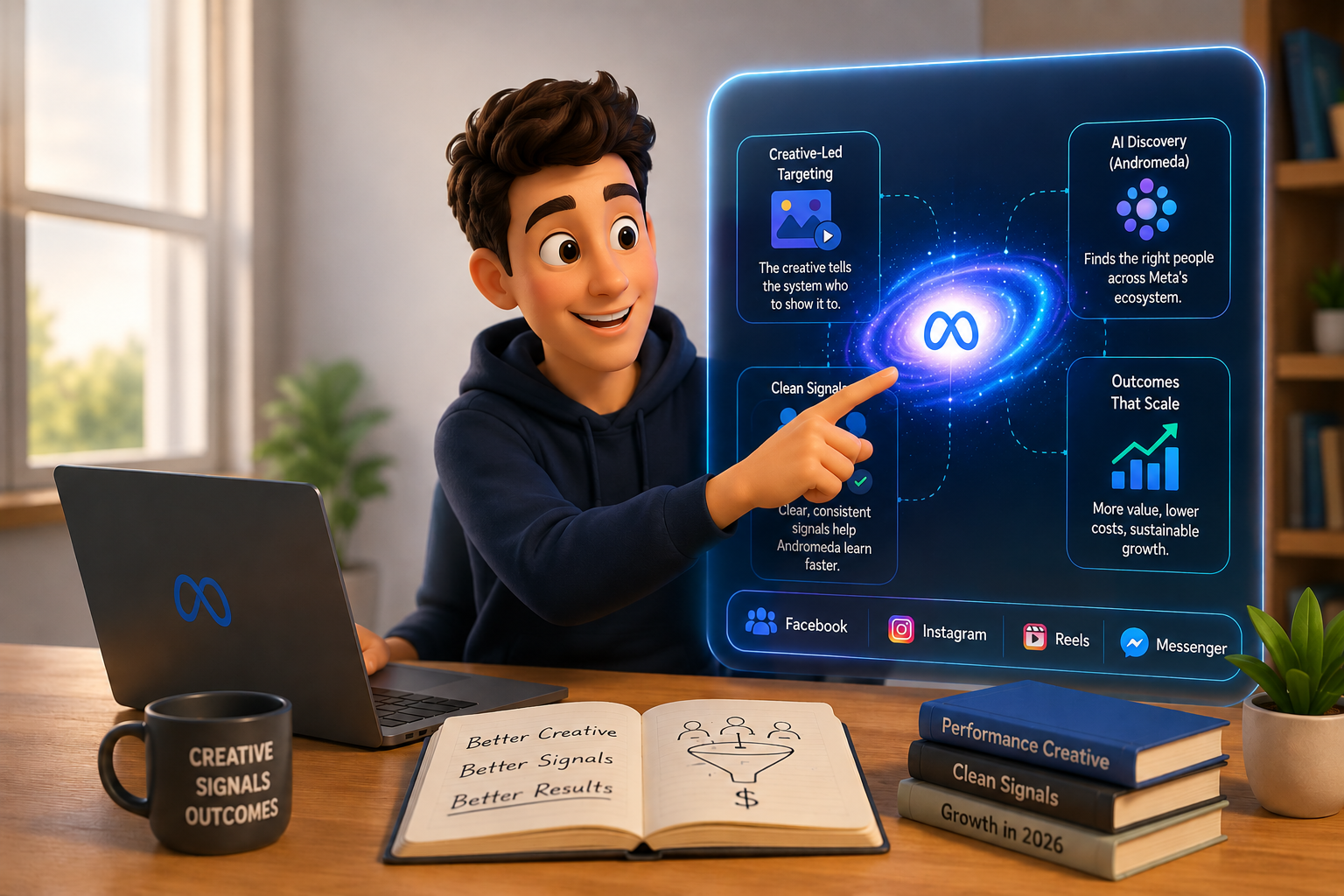
And in March 2026, Meta advertisers across e-commerce experienced what looked like a sudden performance collapse. CPAs spiked. ROAS dropped. Delivery went inconsistent. The panic response was immediate: cut spend, tighten audiences, blame the algorithm.
But the campaigns hadn't changed. Meta's measurement methodology had. Three reporting shifts hit simultaneously. Advertisers were misreading a data story, not a performance story.
The ones who paused, assessed, and held their nerve came out of April stronger. The ones who panicked restructured perfectly good campaigns into rubble.
If you didn't change anything and performance dropped, it's probably not you.
This is the first question I ask every time performance shifts unexpectedly.
What did we change?
If the answer is nothing, that's important information. It rules out campaign-side causes immediately. It means you're looking at something external.
That could be:
Platform-side. Algorithm updates, auction dynamic shifts, measurement changes, delivery changes. Platforms change constantly and rarely announce it loudly. What looks like your campaign underperforming is sometimes the platform recalibrating around you.
Consumer-side. When economic anxiety rises, people pull back. Not permanently, but measurably. Consumer confidence indices directly correlate with willingness to spend. If interest rate news drops or tariff headlines flood the media cycle, your cost per lead might tick up that week. That's not your creative failing. That's people being cautious.
Competitive-side. Other advertisers reacting to volatility often do irrational things with their budgets. Some pull spend, lowering auction competition and potentially creating opportunity. Others panic-bid, driving CPCs up temporarily. These shifts affect your results without you touching a single setting.
Seasonal or cyclical. Sometimes there's no mystery. A slow week is just a slow week.
The point is: a dip without a change on your end is diagnostic data, not a crisis.
Reactive changes make bad data worse.
Here's what happens when you make rapid changes during a volatility event.
You alter targeting. You swap creatives. You adjust bids. You restructure ad sets. The platform resets. You've now introduced new variables into an already noisy environment.
When performance eventually recovers, you won't know why. Was it the change you made? Was it external conditions stabilising? You've muddied the water. You've lost the ability to read what was actually happening.
Worse, you may have broken something that was working. Meta's delivery algorithm needs time and signal volume to optimise. Every significant change interrupts that process. A campaign that would have self-corrected in five to seven days might now take three weeks to recover because you interfered.
The McGraw-Hill study from the 1981 recession found that businesses who maintained their advertising through the downturn saw 256% higher sales by 1985 than those who cut back. Visibility during uncertainty compounds. Absence during uncertainty compounds too, just in the wrong direction.
Stay calm. Read the data properly.
Panic has a way of distorting what you're looking at. Here's a more useful framework when things look rough.
Zoom out the window. A seven-day view will always look worse during a volatile period than a 28-day or 90-day view. What does the trend actually look like? Is this a cliff or a dip?
Separate metrics. Are impressions and clicks holding but conversions dropping? That points to a landing page or demand-side issue, not an ads issue. Are CPMs rising with everything else flat? That's an auction issue, possibly competitive or seasonal. Are leads up but quality down? That's a lead form or follow-up problem.
Check what changed upstream. Platform updates. Attribution window changes. Tracking issues. Pixel fires dropping. A Meta reporting methodology shift. Any of these can make a healthy campaign look sick on paper.
Compare to benchmarks, not just yourself. If costs are up industry-wide, your campaign isn't underperforming. It's performing in line with market conditions. That's a very different conversation.
Give it time. Most genuine volatility events resolve or clarify within two to three weeks. Your job in that window is to observe, not operate.
Keep up to date. Your instincts are valid.
Doing nothing doesn't mean being disengaged. It means being a disciplined observer.
Stay across what's happening. If there's a global economic event, a platform policy change, an algorithm announcement, or a significant shift in your client's industry, you need to know. Not to react, but to contextualise. Context is how you tell the difference between a real problem and a noise event.
Your experience matters here too. If you've run these campaigns for months or years, you have pattern recognition that dashboards can't replicate. You've seen this account in good months and hard months. You know what a real underperformance looks like versus turbulence.
Trust that. The algorithm doesn't have memory. You do.
When should you act?
Doing nothing has a limit. There are times to move.
Act when there's a structural issue. Tracking is broken. The pixel has stopped firing. The website is down. These aren't volatility events. These are operational problems.
Act when you have genuine evidence of a campaign problem. A specific creative is burning out. A targeting segment has exhausted its audience. A landing page change caused a conversion rate collapse. Clear cause, clear fix.
Act when the external environment requires a strategic pivot. Not a panic pivot.
A considered one. If a prolonged economic downturn is fundamentally
changing your client's market, that warrants a strategic review, not a frantic campaign restructure at 9pm on a Tuesday.
And act after you've assessed, not before.
The discipline is in the pause.
Most advertisers overtrade. They move too fast, change too much, and create confusion in accounts that needed time more than they needed optimisation.
The best thing you can do when your campaigns look rough and the world feels chaotic is sit with the data. Read it carefully. Rule out the obvious. Give the algorithms room to work. Trust the fundamentals you've built.
Performance volatility is not a failure state. It's the operating environment. You don't panic when it rains. You check if there's a roof leak, and if there isn't, you wait for it to clear.
Do nothing. Watch closely. Reassess with clear eyes.
That's not passivity. That's professionalism.
Frequently asked questions
How does Google Ads work in 2026?
Google Ads works by predicting intent. You set a goal and provide clean conversion data, keywords, and a landing page. Google's AI decides which searches to enter you into, sets a custom bid for each individual auction based on how likely the person is to convert, and factors in the relevance of your ad and landing page to decide whether and where you show.
What is Google AI Max?
AI Max is a suite of AI features that sits on top of Search campaigns. It expands your reach beyond your exact keyword list using broad match and keywordless technology, finding relevant searches based on your keywords, landing pages, and assets. It works best with Smart Bidding and clean conversion tracking.
Do keywords still matter in 2026?
Yes, but their job has changed. Keywords are now signals that guide Google's AI rather than rigid filters. Clear, well-organised keywords give the system a strong foundation to expand from. Vague ones lead to vague, wasteful matches.
Is broad match safe now?
Broad match is often the best-performing match type in 2026, but only when two things are true: you are using a conversion-based Smart Bidding strategy, and you are actively managing negative keywords. Without both, broad match can surface irrelevant searches and waste budget.
What is Smart Bidding?
Smart Bidding is Google's AI setting a bid for each individual auction in real time, based on how likely that person is to convert. Instead of one manual bid, the system makes thousands of micro-decisions, bidding up on high-intent searches and down on weak ones.
Why are my Google Ads getting more expensive?
Usually one of three things: your account is too fragmented for the AI to learn efficiently, your landing page is dragging down your relevance, or, most commonly, a conversion signal has broken. Check your tracking before you touch your bids.
What is the difference between AI Max and Performance Max?
AI Max works inside your Search campaigns, expanding keyword targeting and assets. Performance Max runs across all of Google's inventory, Search, Display, YouTube, Gmail, Discover, and Maps, using asset groups and audience signals instead of keywords. Many strong accounts use both, with clear separation to prevent them competing against each other.
Does my landing page affect my Google Ads cost?
Yes. Google grades your landing page for speed, relevance, and trustworthiness, and uses that to decide how often you show and what you pay. A fast, focused landing page lowers your cost per click. A slow or off-message page raises it.
How long until Google Ads start working?
Smart Bidding needs a learning period to gather enough conversion data, often one to two weeks, before delivery settles. The most common mistake is resetting campaigns or bids during this phase, which forces the system to start learning again.
Can I learn to run Google Ads myself?
Yes. Because the platform now rewards clarity over manual tricks, the fundamentals are more learnable than ever. A focused guide like The Google Ads Playbook walks you through the structure, signal, landing page, and scaling system step by step so you can run profitable campaigns without an agency.
Book A Session With A Sydney-Based Digital Marketing Expert.
I work with a limited number of clients to keep quality high and focus sharp. If you’re ready to grow and want to see if we’re the right fit, fill out the form and let’s start the conversation.
More Insights & Strategies